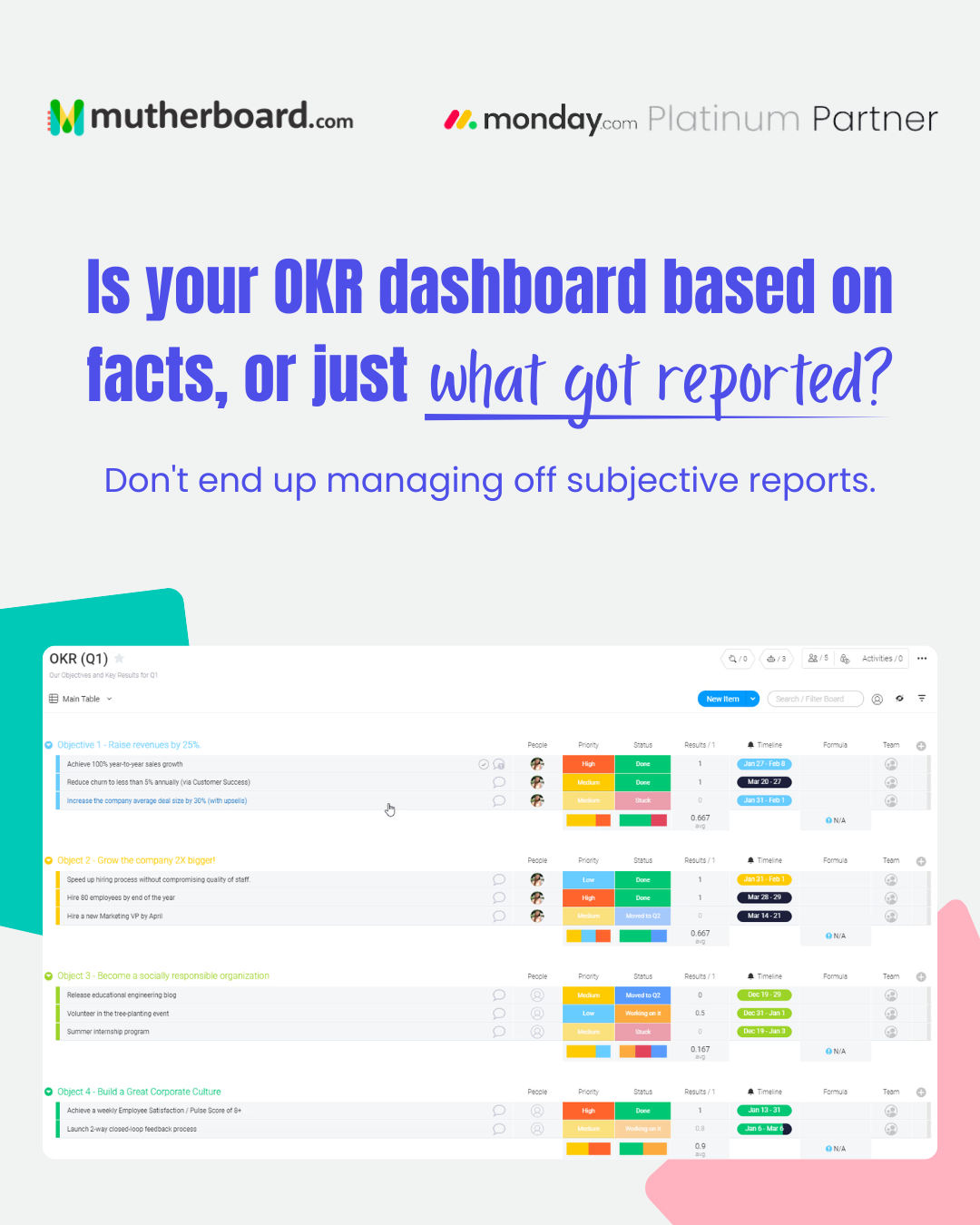
Every leadership team wants the same thing from their OKRs. Clarity. Confidence. A clear picture of whether the business is moving in the right direction.
But here's the question that often gets overlooked:
How much of your dashboard is based on actual business data, and how much is based on what people have reported?
Those are two very different things.
An OKR dashboard can look polished, colourful, and reassuring while hiding the fact that much of the information is manually updated, subjective, or already out of date. If the data feeding your dashboard isn't reliable, then the decisions you make from it won't be either.
The Hidden Problem with Manual Reporting
Most businesses don't intentionally create unreliable dashboards.
It usually happens because information lives in different systems. Teams work in project management platforms, CRMs, finance tools, support systems, spreadsheets, and emails. Bringing all of that together often means someone has to manually collect updates, chase people for progress, and compile reports before leadership meetings.
By the time the dashboard is updated, reality has already moved on.
Even worse, manual reporting often introduces bias. People naturally want to present progress positively. Tasks that are "almost done" become "on track." Delays are softened. Risks are mentioned later than they should be.
No one is trying to be misleading, but the result is the same. Leadership ends up making decisions based on perception instead of evidence.
The Cost of Decisions Based on Assumptions
When your OKRs rely on subjective updates, small inaccuracies compound over time.
A project appears healthy until deadlines suddenly slip.
A sales target looks achievable until the end of the quarter.
A resourcing issue isn't visible until key people become overloaded.
None of these problems appear overnight. They build gradually while dashboards continue telling a reassuring story.
That's why so many organisations are caught off guard by issues they "didn't see coming."
Often, the warning signs were there all along. They just never made it into the report.
Great OKRs Start with Great Data
The strongest OKR dashboards don't rely on someone remembering to update a status column every Friday.
They connect directly to the systems where work actually happens.
Project completion data updates automatically.
Sales numbers come directly from the CRM.
Customer metrics flow in from support platforms.
Financial information reflects live performance.
Instead of asking, "Can someone update this before tomorrow's meeting?" leaders can ask, "What is the data telling us right now?"
That shift changes everything.
Automation Creates Trust
Automation isn't just about saving time. It's about improving confidence.
When data flows automatically between systems, everyone works from the same source of truth.
Teams spend less time creating reports and more time solving problems.
Managers stop chasing updates.
Executives stop questioning whether the numbers are accurate.
Instead of debating the data, they can focus on making better decisions.
AI Makes the Picture Even Clearer
As businesses adopt AI, trustworthy data becomes even more important.
AI can identify trends, predict risks, highlight bottlenecks, and surface opportunities much faster than humans can.
But AI is only as good as the information it receives.
If your dashboard is built on inconsistent or incomplete reporting, AI will simply produce faster versions of unreliable insights.
Reliable automation and connected systems create the foundation that allows AI to deliver real business value.
Ask Yourself One Simple Question
The next time you look at your OKR dashboard, ask yourself:
Am I looking at facts, or am I looking at what happened to get reported?
The answer could reveal more about your business than the dashboard itself.
Because the best decisions aren't made with the nicest looking reports.
They're made with the most reliable data.